
Learning system
Our learning system runs on spaced repetition and on testing.
There is no theory of our own here. The forgetting curve is Ebbinghaus's, the box principle is Leitner's, and the evidence that spacing works comes from research we did not do. What is ours is the choice to apply it, and the limit we draw around it.
What you learn drains away
01 · The forgetting curve
A training day without a follow-up is largely wasted money. That is not an opinion about trainers, it is how memory works.
Hermann Ebbinghaus was the first to map it, in 1885. He taught himself lists of nonsense syllables and then measured how much he still knew after an hour, a day and a week. What came out is the forgetting curve: steep at first, flatter afterwards.
Do not take his percentages literally. It was one subject, himself, with material deliberately about nothing. A working day is not a laboratory and a colleague learning Copilot is not a syllable. The pattern itself has been found again ever since, and that is the part that matters.
The practical translation is not complicated: repeat something just before you would forget it, and next time the interval can be longer. The rest of this page hangs on that.
What the curve is not about
The curve says something about remembering, not about willingness or ability. Someone who does not use Copilot because their manager does not expect it has forgotten nothing. That is a different problem and it needs a different answer.
Why spacing works
02 · Three mechanisms
01
Spacing it out
Two half hours a week apart deliver more than one full hour. Not because you work harder, but because the second time you first have to retrieve what you already knew. That retrieval is the work.
02
Testing yourself, not rereading
Reading a text again feels good and does little. Answering a question feels uncomfortable and does a lot. So every block ends with an assignment rather than a summary.
03
Just before it fades
Repeating too early costs time without return, repeating too late means starting over. The moment in between is where the gain sits, and that moment shifts per person and per topic.
Leitner's box principle
03 · How it shifts
In 1972 Sebastian Leitner described a way to track those expanding intervals using shoeboxes and paper cards. Software has replaced the boxes, not the idea.
- 01
Everything starts at the front
A topic you have just covered sits in the first box. It comes back quickly there, because that is where the chance it has already faded is highest.
- 02
Right means moving further back
Answer it correctly and it moves up a box, so it takes longer before you see it again. What you have mastered stops costing you time.
- 03
Wrong means back to the front
If it goes wrong, the topic goes back to the start. Not as a punishment: it is the signal that the previous gap was too wide.
- 04
So it sorts itself out
Nobody has to decide what you find hard. What you keep missing returns more often, what you already know barely returns at all. Two colleagues end up with different schedules from the same training.
LimitHow many boxes there are and how many days sit between them is not something we put here. Those gaps move with what a participant does, and a figure on this page would harden into a promise the next version already breaks. What is fixed is the ceiling: never more than one message per week.
What that means here
04 · In practice
The theory belongs to others. This is what we do with it, and it is deliberately unimpressive.
After the certificate, reinforcement runs on for 60 days. In that period there is at most one message per week per person, and a client cannot raise that limit. The moments themselves expand: the first reminder comes within a week, the last only after seven.
What we act on is a module you completed but then never touched again. Not your score. A practical assignment also only unlocks days after the certificate, so there is something to do and not just something to read. What that looks like is on the training.
If someone does not respond three times, it stops. That is not leniency but self-preservation: a system that keeps nagging loses its credibility, and the next training with it.
What it does not do
05 · The limits
It is not a flashcard app
You learn to work with Copilot here, not to memorise vocabulary. What returns is a short assignment in your own work, not a card with a fact on it.
We do not measure real time
Study load is not time spent. We look at what you completed and what you left alone afterwards. Measuring how long you stared at a screen is supervision, not learning.
It guarantees nothing per person
Spacing raises the chance that something sticks. It is not a promise that everyone knows everything after 60 days, and anyone promising that has not read the research.
The curve does not predict you
Ebbinghaus's figures come from a laboratory with nonsense syllables. They show the direction. They say nothing about how much your organisation still knows in week six.
What it looks like
06 · From the platform
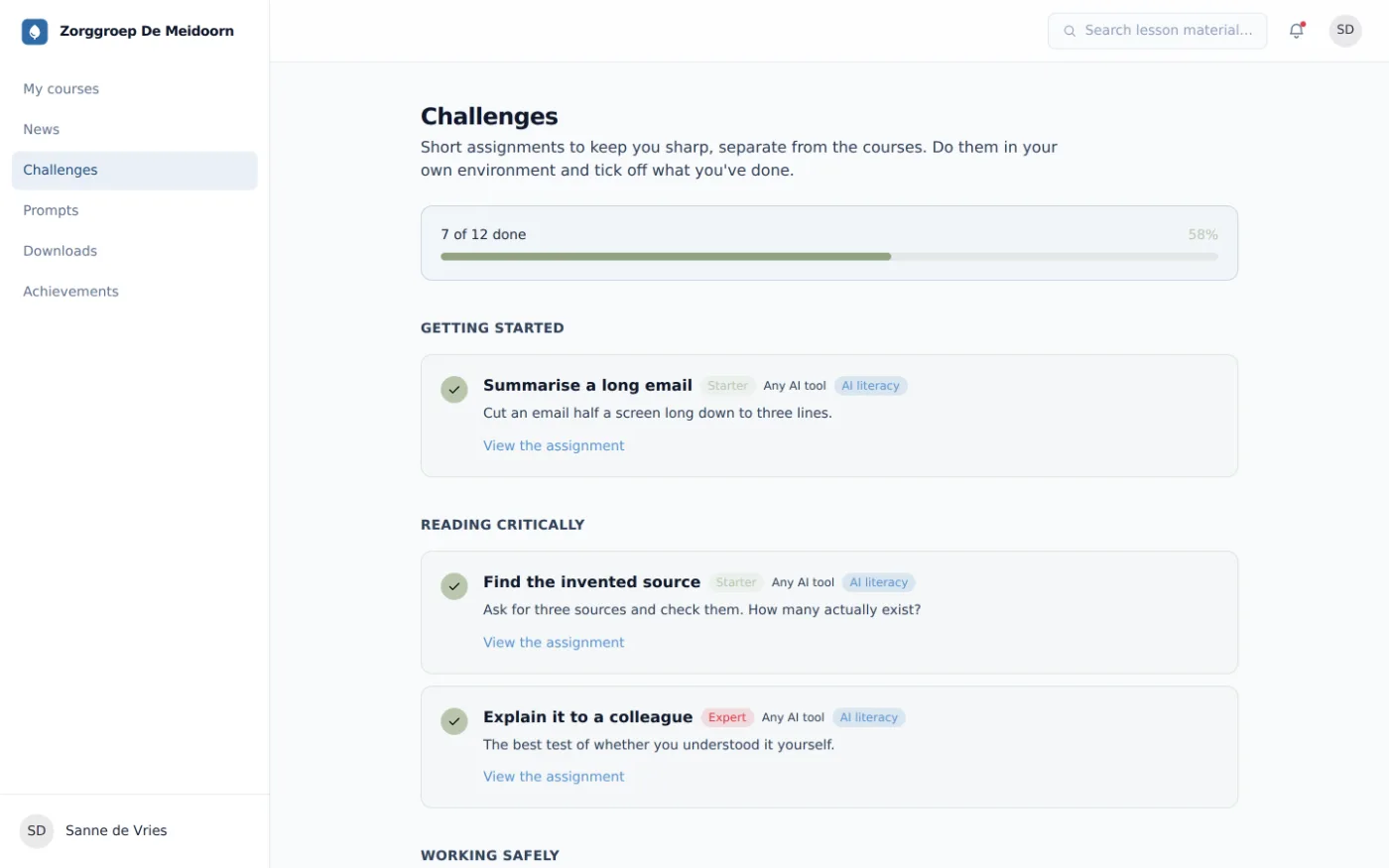
The assignments that return after the certificate, as a participant sees them. The organisation and the figures in this image are made up.
Questions about the learning system
07 · Short answer
Is this the same as Anki or Duolingo?
The principle underneath is the same, the content is not. Those apps repeat isolated facts you memorise. We repeat an action in your own work: a prompt you write yourself, on a document that is yours.
Why 60 days and not a year?
60 days is long enough to run through a few expanding intervals and short enough to still belong to the training. What comes after that is no longer repetition but reference: the prompt gallery and the assignments stay available for twelve months.
What happens if someone does not respond?
Three times without a response means stopping. A system that keeps nagging first gets ignored and then resented, and by then the next training is burnt too. Participants are also free to switch it off entirely.
Can we adjust the pace?
You choose between off, calm and tight. Upwards it never goes beyond one message per week per person, not even on request. What that choice looks like is on the page for employers.
How do you decide what comes back?
On a module you completed but then stopped using. That is a different signal from your score, and deliberately so: a good mark on a module you never open again says little about what you actually use.
What this leans on
08 · References
Four publications, with author and year so you can look them up at the publisher yourself. We do not link to them: the first two are books from 1885 and 1972, and the last two sit behind their journal's paywall.
- The forgetting curve
Ebbinghaus, H. (1885). Über das Gedächtnis: Untersuchungen zur experimentellen Psychologie. Duncker & Humblot, Leipzig.
- The box principle
Leitner, S. (1972). So lernt man lernen. Herder, Freiburg.
- Spacing
Cepeda, N. J., Pashler, H., Vul, E., Wixted, J. T., & Rohrer, D. (2006). Distributed practice in verbal recall tasks: A review and quantitative synthesis. Psychological Bulletin, 132(3), 354–380.
- Spacing and testing
Dunlosky, J., Rawson, K. A., Marsh, E. J., Nathan, M. J., & Willingham, D. T. (2013). Improving students' learning with effective learning techniques. Psychological Science in the Public Interest, 14(1), 4–58.
Read on
- The eight modules
What returns in terms of content, per module, and how the training adapts.
- Setting the pace
Off, calm or tight, with a ceiling you cannot raise.
- Why online first
You cannot space anything out in a room you can only clear once.
Want to see what returns in week six?
In half an hour we walk through the reinforcement with sample data: which message at which moment, what it was selected on, and what a participant notices.